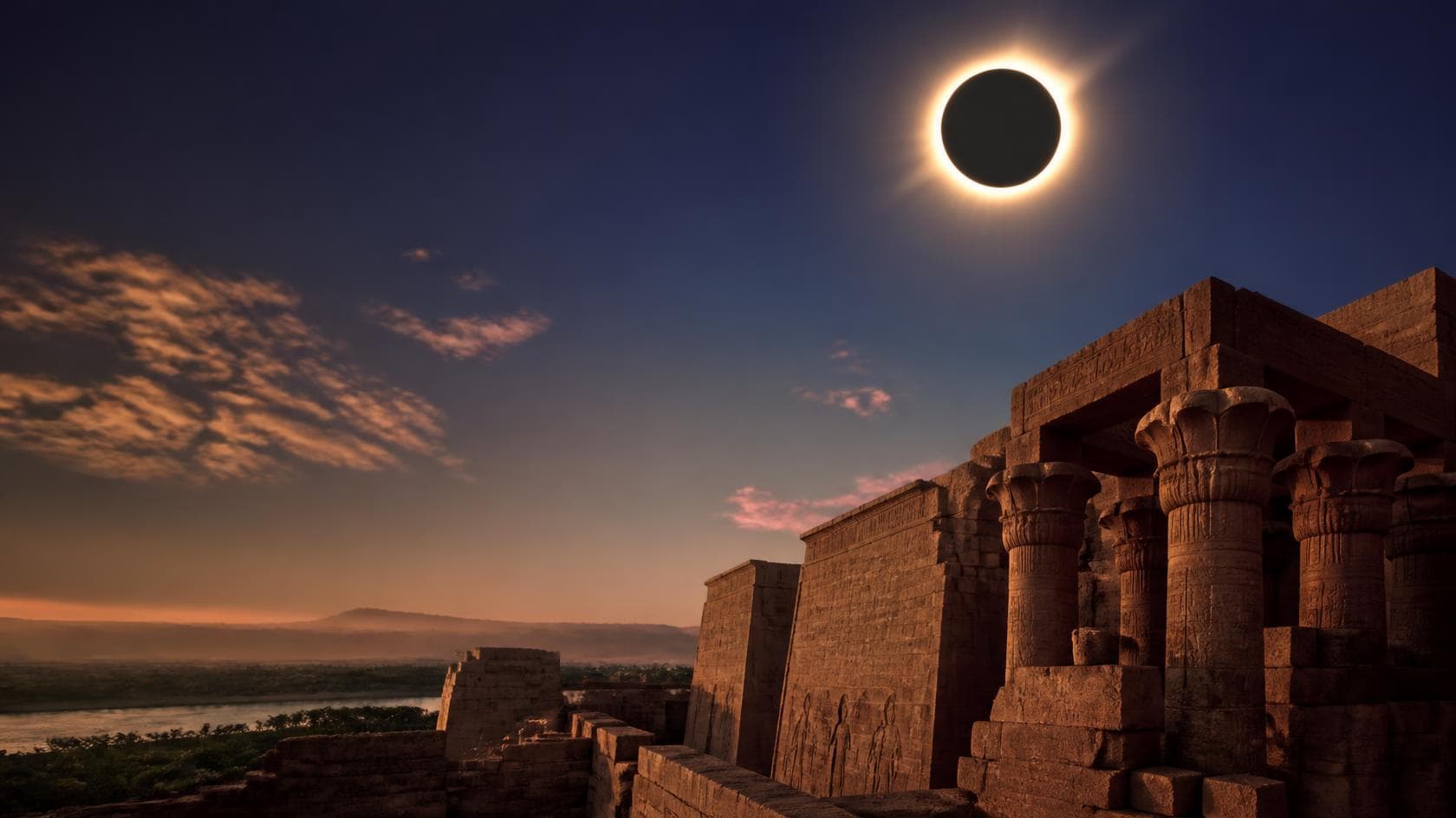

<h2>What is a solar eclipse?</h2><p>A solar eclipse happens when the <strong>Moon passes between the Sun and Earth</strong>, blocking some or all of the Sun's light from reaching parts of the planet.</p><p>The basic geometry is simple: Sun → Moon → Earth. But the phenomenon only works because of a coincidence.</p><p>The Sun is roughly 400 times wider than the Moon, but also about 400 times farther away, so the two appear nearly the same size from Earth. That's what lets the much smaller Moon sometimes cover the Sun's entire visible disk.</p><p>According to NASA, the Moon's shadow has two parts: the darker <strong>umbra</strong>, where the Sun can be completely blocked, and the lighter <strong>penumbra</strong>, where only part of the Sun is covered.</p><h2>Why solar eclipses don't happen every month</h2><p>The Moon orbits Earth roughly once a month, and there's a new moon each time around. So why isn't there a solar eclipse every month?</p><p>The answer is the Moon's orbital tilt. Its orbit is tilted about five degrees relative to Earth's path around the Sun, so most months the Moon passes slightly above or below the alignment needed for its shadow to reach Earth.</p><p>Only when the geometry lines up can the Moon's shadow fall across Earth's surface. NASA calls these windows <strong>eclipse seasons</strong>, the periods when the Moon's orbital position makes an eclipse possible.</p><h2>Types of solar eclipse</h2><p>Not every solar eclipse looks the same; the type depends on how the Sun, Moon, and Earth line up.</p><h3>Total solar eclipse</h3><p>A total solar eclipse happens when the Moon fully covers the Sun's disk. Anyone standing inside the umbra, the Moon's darkest shadow, experiences totality: the sky darkens dramatically, the corona becomes visible, and daylight briefly resembles twilight. This is what Egypt will see on August 2, 2027.</p><h3>Partial solar eclipse</h3><p>During a partial eclipse, the Moon covers only part of the Sun. Anyone in the wider penumbra, outside the path of totality, sees the Sun partly blocked. It can still be worth watching, but it doesn't bring the same darkness or reveal the corona.</p><h3>Annular solar eclipse</h3><p>An annular eclipse happens when the Moon passes in front of the Sun but looks slightly smaller than it. Instead of blocking the Sun completely, the Moon leaves a bright ring around itself, sometimes called a "ring of fire" eclipse.</p><h3>Hybrid solar eclipse</h3><p>A hybrid eclipse is rarer still. Depending on exactly where you're standing, the same eclipse can look total in some places and annular in others.</p><h2>What happens during a total eclipse</h2><p>A total eclipse doesn't happen all at once. It unfolds in stages.</p><h3>1. The partial eclipse begins</h3><p>The Moon starts moving across the Sun's disk. At first the change is subtle: the Sun looks like it's missing a small bite.</p><h3>2. The Sun becomes increasingly covered</h3><p>As the Moon continues across the Sun, daylight begins to change. Shadows can look unusual, the surroundings noticeably dim, and the temperature may drop.</p><h3>3. Totality begins</h3><p>Then comes the moment eclipse travelers come for: the Moon fully covers the Sun. For a few minutes, the bright solar surface disappears and the corona becomes visible around the Moon's dark silhouette. The sky can get dark enough to see a few bright stars and planets.</p><h3>4. Totality ends</h3><p>The Moon starts moving away from the Sun. A brilliant point of sunlight reappears, sometimes called the <strong>diamond ring effect</strong>, followed by the return of the partial eclipse.</p><h3>5. Daylight returns</h3><p>The Moon continues across the Sun until the eclipse ends. The whole event runs much longer than totality, but the period of complete darkness is measured in minutes.</p><h2>Why totality is so short</h2><p>The Moon's shadow is small compared with Earth. As the Moon orbits and Earth rotates, that shadow moves quickly across the planet, tracing a narrow <strong>path of totality</strong>.</p><p>That's why two people watching the same eclipse from different spots can have completely different experiences: someone inside the path gets several minutes of complete coverage, while someone even a short distance away might see only a partial eclipse. It's also why eclipse travelers are so particular about exactly where they stand.</p><h2>How rare is a total eclipse?</h2><p>Total eclipses aren't rare on a global scale; they happen somewhere on Earth periodically. What's rare is seeing one from a particular spot. The path of totality is narrow compared with the much larger area that experiences a partial eclipse, so the same city can wait many years, sometimes far longer, before totality passes over it again.</p><p>That's what makes eclipse tourism different from other travel. You're not going somewhere because you want to visit it. You're going because the Moon's shadow will cross that exact spot on one specific day. Miss it, and you can't just come back the following week.</p><h2>The 2027 eclipse</h2><p>The next total solar eclipse to cross Egypt happens on <strong>August 2, 2027</strong>. The path runs through southern Spain, North Africa, and parts of the Middle East, and several locations in Egypt, including Luxor, will experience totality.</p><h3>Totality in Luxor</h3><p>Current calculations show Luxor will experience:</p><ul><li><p><strong>Date:</strong> August 2, 2027</p></li><li><p><strong>Eclipse type:</strong> Total solar eclipse</p></li><li><p><strong>Totality:</strong> approximately 6 minutes 22 seconds</p></li><li><p><strong>Maximum eclipse:</strong> approximately 1:05 PM local time</p></li><li><p><strong>Partial eclipse begins:</strong> approximately 11:40 AM</p></li><li><p><strong>Partial eclipse ends:</strong> approximately 2:26 PM</p></li></ul><p>These are current projections and worth checking again closer to the event.</p><p>Totality itself is just a few minutes within an eclipse event that runs about <strong>2 hours 46 minutes</strong> in Luxor from start to finish.</p><h2>What makes the 2027 eclipse in Egypt special</h2><p>A few things.</p><p>Totality here is long: Luxor gets more than six minutes, among the longest stretches anywhere along the eclipse's path. The National Solar Observatory puts the figure at around 6 minutes 22 seconds.</p><p>Egypt also offers something few eclipse destinations can match: watching one of the sky's most dramatic events from among the temples of ancient Thebes. For travelers, the eclipse becomes part of a bigger trip that can include the Nile, Karnak Temple, the Valley of the Kings, Hatshepsut Temple, and the rest of Upper Egypt's archaeological sites.</p><h2>Other places in Egypt to see totality</h2><p>Luxor isn't the only Egyptian location in the path of totality. Current calculations for a few others:</p><table><tbody><tr><th rowspan="1" colspan="1"><p>Location</p></th><th rowspan="1" colspan="1"><p>Approximate Totality</p></th></tr><tr><td rowspan="1" colspan="1"><p>Luxor</p></td><td rowspan="1" colspan="1"><p>6 min 22 sec</p></td></tr><tr><td rowspan="1" colspan="1"><p>Asyut</p></td><td rowspan="1" colspan="1"><p>6 min 8 sec</p></td></tr><tr><td rowspan="1" colspan="1"><p>Siwa Oasis</p></td><td rowspan="1" colspan="1"><p>5 min 31 sec</p></td></tr></tbody></table><p>The exact experience depends on exactly where within the path you're standing.</p><p>Cairo, by contrast, gets a partial eclipse, not totality: current projections put it at about 94.7% of the Sun covered at maximum. That distinction matters. Being in Egypt isn't enough if your goal is totality — you need to be inside the path.</p><h2>Why Luxor works so well for this</h2><p>Luxor is already one of the world's major archaeological destinations. Thebes stood here in antiquity, and the area holds monuments spanning thousands of years of Egyptian history, among them:</p><ul><li><p>Karnak Temple</p></li><li><p>Luxor Temple</p></li><li><p>Valley of the Kings</p></li><li><p>Temple of Hatshepsut</p></li><li><p>Colossi of Memnon</p></li><li><p>The temples and monuments along the Nile</p></li></ul><p>The 2027 eclipse adds to that. For a few minutes, the same sky ancient Egyptians once watched becomes the stage for a modern astronomical event.</p><h2>What the sky looks like during totality</h2><p>How quickly things change is part of what makes a total eclipse so striking. As totality approaches, daylight fades and the horizon can hold onto strange colors while everything around you darkens.</p><p>During totality itself, the Sun's bright surface disappears, the corona appears around the Moon, and depending on conditions, you might see a few bright stars and planets too.</p><p>Photos can show what it looks like. They don't really capture what it feels like to watch daylight disappear around you.</p><h2>Can you look directly at a solar eclipse?</h2><p>Never look directly at the Sun during the partial phases without proper solar eye protection — regular sunglasses aren't enough. Use certified eclipse glasses or proper solar viewing equipment whenever any part of the Sun's disk is visible.</p><p>During totality itself, when the Sun is fully covered, you can look at the corona without filters. Put your eye protection back on the moment the bright solar surface starts to reappear.</p><p>NASA advises the same: proper eye protection any time you're outside the brief period of totality.</p><h2>How to prepare for the 2027 eclipse</h2><h3>Pick your viewing spot carefully</h3><p>Being in the same country doesn't guarantee totality. Check whether your chosen destination lies inside the path.</p><h3>Build your trip around August 2, 2027</h3><p>Unlike a normal vacation, this date can't be moved. The eclipse happens on one specific day.</p><h3>Check the weather odds</h3><p>Even with perfect astronomical timing, clouds can block your view. Eclipse travelers often look at historical weather patterns for a location before deciding where to stand.</p><h3>Bring eye protection</h3><p>Bring certified eclipse glasses, or get them from a reliable source.</p><h3>Sort out transport and accommodation early</h3><p>Popular viewing locations can get busy as the date approaches. Booking accommodation and transport early makes the whole trip easier.</p><h2>Why pair the eclipse with a wider Egypt trip</h2><p>The advantage of choosing Egypt for the 2027 eclipse is that the trip doesn't have to be only about the eclipse.</p><p>Before reaching Luxor, you could see the Pyramids, the Sphinx, and the Grand Egyptian Museum in Cairo, travel south to Aswan for Philae Temple and Abu Simbel, then sail the Nile past Kom Ombo and Edfu on the way to Luxor, where the eclipse happens.</p><p>That makes it less an eclipse trip and more an Egypt trip built around one extraordinary day.</p><h2>A note for travelers planning this trip</h2><p>If you're planning to visit Egypt specifically for the August 2, 2027 total solar eclipse, Gentoura offers a dedicated Egypt itinerary combining Cairo, a Nile cruise, Aswan, and Luxor, with the eclipse built into the journey.</p><p><a href="https://gentoura.com/en/egypt/travel-packages/culture-classic/egypt-total-solar-eclipse-tour-cairo-nile-cruise-luxor-2027">Explore Gentoura's Egypt Total Solar Eclipse Tour – Cairo, Nile Cruise & Luxor 2027</a></p><p></p><p>It's built for travelers who want the eclipse alongside Egypt's major historical and cultural sites.</p><h2>Final thoughts</h2><p>A total eclipse lasts only a few minutes, but getting there can turn into one of the more memorable trips you'll take.</p><p>On August 2, 2027, the Moon will pass between Earth and the Sun, briefly transforming the daytime sky along the path of totality. In Luxor, that happens above one of the world's great archaeological sites — a chance to combine a rare astronomical event with some of ancient Egypt's most significant history.</p>
#solar eclipse in Egypt 2027#total solar eclipse Egypt 2027#Egypt solar eclipse 2027#solar eclipse Luxor 2027#August 2 2027 solar eclipse#2027 total solar eclipse#where to see solar eclipse in Egypt#Luxor eclipse 2027#Egypt eclipse travel#solar eclipse travel#total eclipse Egypt
Share article: